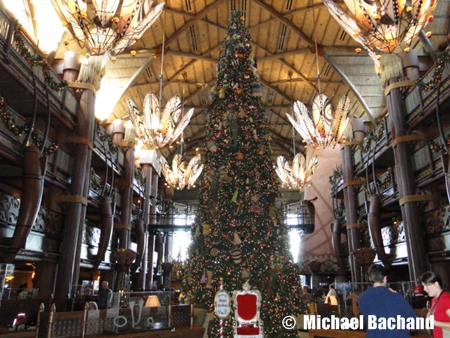
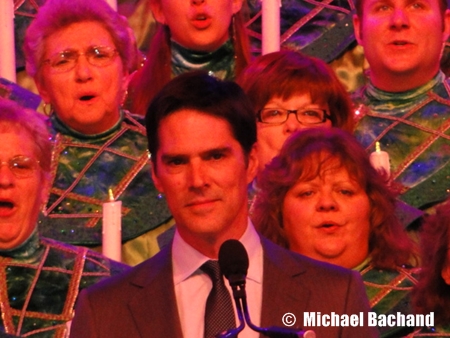
Anyone who has visited Walt Disney World during Christmas time is well aware of Mickey's Very Merry Christmas Party, the Candlelight Processional and the Osborne Family Spectacle of Dancing Lights. Many may also have visited some or all of the Disney hotels to take in the beautiful Christmas decorations and those incredible chocolate and gingerbread creations. But how many have taken the time to stop and listen to the wonderful storytellers in each of the World Showcase pavilions in Epcot?
Well, today we're going to do that together. We are going to start with Canada and work our way all around the World Showcase and finish in Mexico. Along the way, we're going to learn a little about the holiday traditions that are celebrated in each of the countries. I can assure you this is going to be a really fun walk.
So, maybe you want to put on your Santa hat and take a cup of eggnog to sip as we stroll.
Let's begin by taking a peek at the Festival Guide, go over the map and then check out the times.
As we enter Epcot we'll be sure to pick up a copy of the Holiday Festival Guide. They are located at both entrances as well as at various shops and other locations throughout Epcot.

Inside the Festival Guide you'll find a Festival Guidemap with information on the storytelling in each of the World Showcase pavilions.

What you won't find in the Festival Guide is a schedule as to the show times. We'll also need to get an Epcot Times Guide. However, the Times Guide only gives the beginning and ending times of the shows and not the actual performance schedule. For that we'll have to check the "Entertainment signs" located in front of each pavilion.

Our first stop is Canada.
As I just mentioned, it's these "Entertainment signs" that give you the actual times where you can see the storyteller. Here you can see the times for the eight shows.

As you will see, most, but not all, of the pavilions have a scroll next to the storytelling location These scrolls tell the story of each countries holiday tradition. Here's is what is on the Canada scroll:
"From the waterways of eastern Newfoundland to the snowcapped mountains of British Columbia, the Christmas holidays hold special magic for the vast expanse of Canada.
Although favorite traditions such as awaiting Santa Claus, or le Pere Noel, trimming the evergreen, and singing Christmas carols are similar to those commonly found in the Untied States and Europe, Canada has many unique holiday traditions as well.
In some traditional Canadian homes, Santa Claus enlists the help of devilish creatures called Belsnickles to determine which children have been "naughty or nice". The Belsnickles supposedly enter the homes of naughty boys and girls to cause mischief.
Even Canada's Inuit children are visited by mysterious creatures call Naluyuks who travel from house to house. The children must sing Christmas carols to appease the Naluyuks, who pound sticks on the floor before questioning the children about their behavior. When the children say they've been good, which they always do, the Naluyuks open special gift bags full of wonderful presents.
In Quebec, le reveillon, a sumptuous traditional French dinner, is served after Midnight Mass on Christmas Eve.
Most of Canda celebrates Boxing Day on December 26, in honor of the acient English tradition of giving filled Christmas boxes to tradesmen for their help during the year."

The wonderful storyteller pretty much repeated the information found in the scroll, but in a very entertaining way.


What a great storyteller his was! Now on to the United Kingdom.
Show times for Father Christmas in the United Kingdom pavilion.

Here's what's on the United Kingdom scroll:
"Many wonderful Christmas traditions originated in the countries of the United Kingdom. Great Britain, Northern Ireland, Scotland and Wales. Each have unique holiday customs, and many of these have been shared worldwide. Well-known Christmas carols such as "Deck the Halls" and Here We Come a Wassailing" were first sung in the United Kingdom.
The tradition of Christmas cards also began in the United Kingdom. In 1843, John Calcott Horsley sent a card depicting an English family brimming with cheer to his friend Sir Henry Cole. The original card caught the attention of a British giftbook company, which published a thousand lithographed copies and sold them for a shilling each.
Not surprisingly, the hanging of mistletoe is one of the United Kingdom's oldest and most popular traditions, dating back to the Druidic ceremonies of the winter solstice. Each time a kiss was claimed under the mistletoe, the young man would pick off one berry. The kissing would end when all the berries were gone!
For children, Father Christmas, with his long white beard, green robe, and crown of holly, is still treasured as the jolly gift-bearer who brings holiday joy to the well-behaved."

Father Christmas telling his story.


That Father Christmas sure can tell a story. Well, over the bridge to France we go.
Show times for Pere Noel in the France pavilion.

Here is what's on the France scroll:
"The magic of Christmas can be seen everywhere in France. The shops and baraques, or booths, along the beautiful boulevards are brimming with toys, glittering lights, and Christmas decorations of every imaginable kind.
Children eagerly await le Pere Noel (Father Christmas), who arrives on Christmas Eve to deliver wonderful presents. Most churches and homes display a beautiful nativity scene called a creche, which is considered on of the most important symbols of Christmas to the French. Traditionally, candles are lit around the creche: sometimes a special Yule log is also burned on the fire.
After families return from Midnight Mass, they enjoy the feast called le reveillon, which often consists of ham, goose, oysters, salads, cheese, champagne, and Buche de Noel, a delicious chocolate cake shaped like a Yule Log.
Children then set out shoes around the Christmas tree in great anticipation of le Pere Noel who fills them with all sorts of goodies!"

Here Pere Noel tells the story of Christmas in France:


I love the story Pere Noel tells about the sister and her non-believing brother. No coal for me because "I beleive". Morocco next.
Show times for Taarji, the storyteller, in the Morocco pavilion.

Here's what is on the Morocco scroll:
"Two major holidays of Morocco are Eid al-fitr and Eid al-Adha.
One of Morocco's holiest celebrations is the moth of Ramadan, which commemorates the month in which Allah revealed to the Muslin People, the Holy book, The Quran. During the month of Ramadan, Muslims observe a strict fast and participate in various activities including charitable giving and peace-making. It is a time of intense spiritual renewal for those who observe it. At the end of Ramadan, Muslims throughout the world observe a joyous three-day celebration called Eid al-Fitr, the Festival of Fast-Breaking. Eid al-Fitr falls on the first day of Shawwal, the moth which follows Ramadan in the Islamic calendar. It is a time to give charity to those in need, and celebrate with family and friends the completion of a month of blessings and joy.
On the 10th day of Zul-Hijjah, the last month of the Islamic calendar, Muslims around the world celebrate Eid al-Adha, the Festival of the Sacrifice.
People of Morocco also celebrate Ashura. The word "Ashura" literally means "10th", as is it on the 10th day of Muharram, the first month of the Islamic year. Ashura is an ancient observance that is now recognized for different reasons and in different ways among Muslims. In Morocco, one of the most beautiful traditions of Ashura happens after teh sunset. On the night of Ashura, families join together to eat traditional Moroccan dishes and sweets. Kids are given gifts, toys, sweets, and often a special drum called a taarija. From the largest cities to the smallest, bonfires are built by children who sing and dance around it all night. People of Morocco celebrate the joy, color, and traditions of the Feast of Ashura."

Here Taarji tells of Moroccan traditions:


I bet you learned something new here; I sure did. Wonder what Japan has in store for us?
Show times for O Shogatsu, the storyteller, in the Japan pavilion.

Unfortunately there was no scroll in Japan so you'll have to put up with my brief recollection of O Shogatsu's very interesting story.
O Shogatsu, a Daruma doll street vendor, tells the story of a Japanese New Years tradition observed by some Japanese. The Daruma doll is a symbol of perseverance and good luck in Japan. As part of New Year's celebration, Daruma dolls are given as a gift of encouragement. The dolls when purchased does not have eyes painted on them. When the holder of the Daruma doll commits to attain a goal or a big task one eye is painted. The other eye is painted only when the goal is achieved or the task accomplished. So, the Daruma doll serves as both a reminder and a source of encouragement.


What a wonderful storyteller. I love learning new things about these countries, don't you? Well, the American pavilion is next. I should know a little about this history. -:)
Show times for Kwanzaa and Hanukkah story telling in the American pavilion.

Here is what is on the Kwanzaa scroll:
"Kwanzaa is an African-American harvest and community festival that has it's roots in the civil rights era of the 1960's. It was founded as a way of reaffirming african-American identity, instilling knowledge and pride in African roots, and reinforcing bonds among members of the community.
Kwanzaa is devoted to seven principles, known collectively as Nguzo Saba: Umoja (Unity), Kujichagulia (Self-Determination), Ujima (Collective Work and Responsibility), Ujamaa (Cooperative Economics), Nia (Purpose), Kuumba (Creativity), and Imani (Faith).
Although it was first observed solely by African Americans, Kwanzaa is now celebrated by and estimated 18 million people in the United States, Canada, the Caribbean, Britain, India, and some African nations."

Here the storyteller tells how she helped her grandmother understand the significance of Kwanzaa.


Here's what is says on the Chanukah (Hanukkah) sign:
"Chanukah (Hanukkah); The Festival of Lights.
In 165 B.C.E., with the help of neighboring Hasideans, the Maccabees defeated the vastly superior forces of the Syrian King and liberated the city of Jerusalem. Upon entering the Central Synagogue the Maccabees discovered that the temple had been desecrated with the blood and bodies of slain pigs. The sacred Torah scrolls had been burned. The containers of holy oil for the "Eternal Flame" were overturned and spilled out upon the ground. However, a small bottle containing the equivalent of one day's worth of olive oil was discovered intact. The flame was lit using the existing oil and the reconsecration of the temple begun. At least eight days were required to send for and receive more oil for preserving the "Eternal Flame." The flame burned for the entire eight days: Thus was Chanukah instituted by the Maccabees. The eight day celebration begins on the eve of the 25th day of the Hebrew month Kislev (December). One candle on a menorah is lit each day to commemorate the "miracle of the Chanukah" until all eight candles are burning on the last night. The dreidel, a four-sided toy marked with hebrew letters and sun like a top in a game of chance, was created to help tell children the story of Chanukah."

The storyteller shows the dreidel and tells us it's history and that of the Chanukah holy season.


Wow, again more things that I didn't know. What does Italy have in store for us?
Show times for La Befana's story telling in the Italy pavilion.

Again, unfortunately there wasn't a scroll in Italy. So, here we go with my recollection of La Befana's story:
The story goes that La Befana was an old and poor woman who lived at the time of Jesus's birth. She was visited by the three kings and asked to go with them as they searched for the new born child. She declined. She also refused to go with the shepherds who came by as well. When she finally decided to go in search of baby Jesus she gathered up and old doll, one of her few possessions, and set off. Unfortunately she got lost and never found him. So, to this day she visits children's house in search of the baby Jesus and leaves the children gifts.


I kind of felt bad that she never found the baby Jesus! The good news is that the children get gifts from her as she looks for him. On to Germany!
Here's what is on the Germany scroll:
"The German Yuletide season is a magical time when friends and family celebrate together! Many of Germany's rich customs and traditions of the season have been adopted all over the world.
It was Germany who produced the first tannenbaum (Christmas tree). According to legend, while walking in the woods one snowy evening, Martin Luther was overcome by the beauty of the starlight sparkling on the fir trees. As the light from the heavens shone all around him, he was reminded of the star that shone on the night the Chriskindl (Christ child) was born. He wanted to share this magic with his children, so he brought home a fir tree from the forest. He even fashioned a way to clip candles on the tree to make it look as though the branches were covered in glistening snow.
On Heiligabend (Christmas Eve), German parents secretly decorate the tannenbaum with candies, nuts, glass baubles, and twinkling lights. A bell is rung, the tannenbaum is presented, and the children race to open presents and snatch the goodies from the tree."

Here Helga tells the story of the first Christmas tree, the Advent calendar and the nutcracker tradition.


That big nutcracker was pretty cool. Wonder what we'll learn in China?
Show times for the Monkey King in the China Pavilion.

Here is what it says on the China scroll:
"The story of Sun hou-kong, the Monkey King, is an ancient Chinese legend that tells an exciting tale of redemption and enlightenment.
Sun hou-kong, a monkey raised by humans, became the Monkey King when he single-handedly defeated a horrific monster in his homeland. Afterwards, the Monkey King acquired incredible powers when he cleverly uprooted magic stick guarded by the Dragon King. With this magic stick and the ability to do just about anything, the Monkey King started to look for adventure and mischief. Buddha was not pleased with this abuse of power and decided to seal the Monkey King inside a mountain for eternity. The Monkey King quickly realized the error of his ways! Fortunately, a monk named Thang Seng believed in the Monkey King's redemption and asked Buddha to release him. The Monkey King proved to be a loyal comrade to Thang Seng. Like many holiday legends, this heartfelt story sends and important message of hope."

The Monkey King tells his story.


Was that a story about me? Only kidding! I never was a King. -:) Maybe we'll have time to get a quick bite to eat in Norway?
Show times for story telling in the Norway pavilion.

Here is what is one the Norway scroll:
"Christmas is a festive time in the "Land of the Midnight Sun."
On Christmas Eve, farm animals are traditionally treated to the finest oats and barely. Birds are remembered during julenek, when they are offered large sheaves of grain placed high on spruce poles. After darkness it's "lights out" as homes are illuminated by only the warm glow of candlelight.
An elf-like gnome named Julenissen lives in woods and barns across the countryside. Julenissen is the guardian of every family's welfare, so children leave a steaming bowl of porridge in the hayloft during the holidy period to thank Julenissen.
On Christmas Day, many attend church before spending time quietly at home with family members. On Second Christmas Day, children celebrate julbukke by dressing up in costumes and going door-to-door for goodies."

Here's Sigrid and Julenissen telling their story in a very funny way.


Oh my, they were a hoot! I really liked the way they told they story; very funny! Last stop; Mexico.
Show times for story telling in the Mexico pavilion.

Here is what it says on the Mexico scroll:
"Beautiful candlelight processions, happy sounds of children laughing, and sweet smells of the season make Christmas in Mexico a magical, meaningful time of community.
In Mexico, Christmas is called La Navidad and its main celebration is Las Posadas, which means "inn". During Las Posadas, Mexican families recreate the journey of Mary and Joseph seeking shelter in Bethlehem. For nine nights, beginning December 16, Mexican children dress up like the holy family and visit their neighbors as part of a candlelight procession. Beautifully carved nacimientos (nativity scenes) are displayed in homes. Prayers and festivities begin when the procession of Mary and Joseph is welcomed in.
On January 6, the day the Three Kings arrived in Bethlehem, bringing gifts to baby Jesus, Mexican chilfren leave their shoes on the doorsteps in a special celebration called Dia De Los Tres Reyes (Three Kings Day). When the children awaken the next morning, they are delighted to discover wonderful toys and gifts in and around their shoes."

The Three Kings tell their story>


What a way to end, with the Three Kings telling their story! Just wonderful!
I don't know about you, but I had a fantastic time. I loved hearing all those different stories and I loved the job each storyteller did. They were most entertaining and a joy to listen to. I hope you agree.
Besides being entertained, I learned a lot. I hope you came away with a better understanding of how each of these countries celebrate.
Also, I'm sure you noticed that the story of Santa is missing. Santa and Mrs. Claus were at the American pavilion but they were too busy meeting with all the little (and not so little) boys and girls. As you know, they've got a lot to do between now and Christmas Eve.
Well, thanks for coming along. I really enjoyed your company!
Please leave me a comment and tell me what you like about the Holiday Storytelling Around the World or what your memories are of hearing these stories in person. I love to get comments.
Finally, be one of the first people to hear when my newest blogs go live on AllEars.net by joining "DisneyMike's World" Facebook group.
Well, that’s all for now. As my good friend says, “see ya real soon”….DizneyMike