AEN banner

Main

The Walt Disney Family Museum Archives

November 14, 2009

Celebrate Mickey's Birthday at the Walt Disney Family Museum

Celebrate Mickey Mouse’s birthday with us on November 18!

Walt Disney early1930s


Although he had appeared in the animated short Plane Crazy six months earlier, November 18, 1928 is widely recognized as Mickey Mouse’s birthday as it was the day that Steamboat Willie—the first Mickey Mouse cartoon with synchronized sound—was released.

Explore the galleries and discover the Earliest Known Drawings of Mickey Mouse and so much more, including vintage Mickey merchandise, the creation of Mickey’s friends, an interactive station that demonstrates how sound is synchronized to animation, and a special section dedicated to the Mickey Mouse Club. Come celebrate and learn about the birth, history and life of the leader of the club that’s made for you and me: M-I-C-K-E-Y M-O-U-S-E!

The Museum is open from 10AM to 6PM, Wednesday through Monday. For more information, visit www.waltdisney.org or call 415-345-6800.

Blue Line

WEBSITE: waltdisney.org

TWITTER: twitter.com/wdfmuseum

FACEBOOK: http://www.facebook.com/TheWaltDisneyFamilyMuseum

November 6, 2009

The Walt Disney Family Museum December 2009 Events

CONCERTS

December 12th - String Circle Quartet4:00pm, Special Exhibition Hall, 122 Riley Avenue
tickets available online at www.waltdisney.org

Concerts in our Special Exhibition Hall continue to shine light on composers of Fantasia with Schubert’s String Quartet in G. Henry Purcell’s delightful Suite from The Faery Queen—a bit of musical fantasy—is also performed. Joseph Edelberg, Anthony Martin, and Kati Kyme, violins, and Thalia Moore, cello.

Blue Line


December 19th and 20th - Artists’ Vocal Ensemble Concert: A Candlelight Christmas4:00pm, Special Exhibition Hall, 122 Riley Avenue
tickets available online at www.waltdisney.org

Nothing is more magical than a choir performing classic Christmas songs and carols. Our candlelight program will include European Renaissance motets and carols, contemporary American carols and anthems, and an audience sing-along led by Jonathan Dimmock.

Blue Line

FILM

Film of the Month: Christmas with Walt Disney
Christmas with Walt Disney runs until January 4
12:30pm, 3:30pm, 6:30pm, Theater

(except Tuesdays, December 25, January 1, and December 5th at 12:30pm and 3:30pm)
tickets available online at www.waltdisney.org

This special holiday screening includes The Nutcracker Suite from Fantasia (1940), Pluto’s Christmas Tree (1952), scenes from the television Christmas specials, and rarely seen home movies of Walt and his family. See how Walt celebrated Christmas at the Studio, at Disneyland, and at home.

Blue Line

LECTURE

December 5th - Memories of Walt: A Conversation with Legends
2:00pm, Theater
tickets available online at www.waltdisney.org

Join us on Walt’s birthday as we hear from Disney Legends Blaine Gibson, Rolly Crump, and Richard Sherman as they share special memories of Walt. Blaine is the sculptor behind the Hall of Presidents, Rolly is one of the Imagineers behind “It’s a Small World” and “Haunted Mansion” and Richard wrote such Disney music classics as “It’s a Small World” and “Chim Chim Cher-ee”. It will be an extraordinary afternoon filled with stories, laughter, and reflection.


December 25th – Christmas Day
Museum is closed


WEBSITE: waltdisney.org

TWITTER: twitter.com/wdfmuseum

FACEBOOK: http://www.facebook.com/TheWaltDisneyFamilyMuseum

September 25, 2009

Sneak Peek - The Walt Disney Family Museum - Gallery 10

Gallery 10 - Remembering Walt Disney

Mickey Crying

Walt Disney died on December 15, 1966. Reactions from around the world, in newspaper articles, editorial comment, and letters and telegrams present an appreciation of the joy, hope, and inspiration Walt provided to millions of people around the world.

WEBSITE: waltdisney.org

TWITTER: twitter.com/wdfmuseum

FACEBOOK: http://www.facebook.com/TheWaltDisneyFamilyMuseum


September 21, 2009

The Walt Disney Family Museum Public Events Program

The Walt Disney Family Museum is launching its public events program with a series of screenings, lectures, and concerts. Highlights include a special concert—featuring a number of well-known Disney classics—at Davis Symphony Hall with the San Francisco Symphony on October 16.

Inaugural Screenings, Lectures, and Concerts Launch The Walt Disney Family Museum Public Event Programs

Rarely Seen Films, An Animated Classic, and Classical Music in a Dazzling New San Francisco Performance Space and Theater

San Francisco Symphony Performs Special Concert at Davis Symphony Hall In Celebration of The Walt Disney Family Museum’s Grand Opening

 Walt Disney Family Museum Logo

A series of inaugural events celebrate the opening of The Walt Disney Family Museum and the multi-faceted interests of its namesake, Walt Disney, from October 1-31, 2009. From a screening of Mickey Mouse’s starring turn in Fantasia from October 1-19 to a chilling Halloween showing of legendary animated shorts The Skeleton Dance, The Mad Doctor, and Pluto’s Judgment Day. The series pays homage to the artistic output and inspirations of Walt Disney.

Highlights of opening month festivities include a concert by the San Francisco Symphony with classical works heard in Fantasia and orchestrations of themes and songs from Pinocchio and Mary Poppins. Other notable events include a special screening of Walt and El Grupo, a documentary about Disney’s 1941 trip to South America that resulted in two feature films and numerous animated shorts.

Most screenings and performances will be held in the museum’s 114-seat auditorium, which features murals of Mickey Mouse as the Sorcerer’s Apprentice. Exceptions are noted.


FILM

Film of the Month: Fantasia October 1st - 19th Only 12:30 p.m., 3:30 p.m., 6:30 p.m., Theater Non-Member: Adult $10, Child $8, Child under 6 $6 Member: Adult $8, Child $6, Child under 6 $4 Tickets for sale online Let your imagination soar as you watch colors, flowers, and fairies swirl and dance on screen to the timeless compositions by Johann Sebastian Bach, Paul Dukas, and Igor Stravinsky in Disney’s Fantasia. This unforgettable experience will take place in our new state-of-the-art theater under the watchful eyes of Mickey, the Sorcerer’s Apprentice, whose likeness decorates the theater walls.

October 23th - 25th – South of the Border Weekend - In 1941 Walt Disney and a group of Disney artists traveled to South America on a Good Neighbor tour at the request of the United States government. This was no ordinary handshake tour for Walt and his group. It offered the Disney team a unique opportunity to learn about culture and traditions south of the border. As a result of the visit, Walt Disney created two successful features, Saludos Amigos and The Three Caballeros, and numerous short subject films.

October 23rdWalt and El Grupo Preview Screening & Discussion with filmmaker Ted Thomas and author J.B. Kaufman (one showing only) 7 p.m., Theater $8 Members Only Tickets for sale online

October 24th – Screening of The Three Caballeros and Discussion of the Good Neighbor Tour and book signing with J.B. Kaufman 1:00 p.m. to 3:00 p.m. Book Signing, Learning Center Free Book Signing, no tickets required 3:30 pm to 6:00 pm Film and Discussion, Theater Non-Member: Adult $10, Child $8, Child under 6 $6 Member: Adult $8, Child $6, Child under 6 $4 Tickets for sale online

Noted author and historian J.B. Kaufman will be at the Museum October 24 from 1:00 pm to 3:00 pm, signing his new book, South of the Border With Disney: Walt Disney and the Good Neighbor Program, 1941-1948. The book chronicles the full story of the Disney Good Neighbor project, from the 1941 South American trip through production of all the studio's Latin American films. Then join us from 3:30 pm to 6:00 pm for a special screening of The Three Caballeros. Following the film, J.B. Kaufman will discuss the South American tour and this unique film.

October 25th – Screening of Saludos Amigos followed by a Q & A with J.B. Kaufman 4:00 p.m. to 6:00 p.m., Theater Non-Member: Adult $10, Child $8, Child under 6 $6 Member: Adult $8, Child $6, Child under 6 $4 Tickets for sale online We conclude this South of the Border weekend with a screening of Saludos Amigos. J.B. Kaufman will be on hand to answer questions regarding the lively film.

October 30th and 31st – HallowScreen! – The Skeleton Dance and Other Bone-Chilling Cartoons 10:30 a.m., 12:30 p.m., 2:30 p.m., 4:30 p.m., 6:30 p.m., 8:30 p.m., and 10:30 p.m., Theater Non-Member: Adult $10, Child $8, Child under 6 $6 Member: Adult $8, Child $6, Child under 6 $4 Tickets for sale online Tickle your Halloween funny bone with the spooky adventures of skeletons, mice, spiders, and bats. We will screen some of Walt Disney’s haunting cartoon shorts such as The Skeleton Dance, Mad Doctor, Pluto’s Judgment Day, and many more. You’ll have a “howling” good time!

MUSIC

October 11th – Artists’ Vocal Ensemble Concert: The Classics 4 p.m., Special Exhibition Hall Non-Member: Adult $20, Child $15, Child under 6 $13 Member: Adult $15, Child $10, Child under 6 $8 Tickets for sale online The Artists' Vocal Ensemble will enchant you with melodies of the world's greatest melodic composers, Felix Mendelssohn, Franz Josef Haydn, and Franz Schubert (one of the composers heard in Fantasia). Directed and accompanied by Jonathan Dimmock (piano), this will be an afternoon of chamber music evocative of the great salons of Vienna and performed in our beautiful Special Exhibition Hall.

October 16th – The San Francisco Symphony Celebrates the Opening of The Walt Disney Family Museum (our Theater Dark) 7:30 p.m., Davies Symphony Hall
$15-70, tickets for sale at www.sfsymphony.org Relive the magic of your childhood favorites as the San Francisco Symphony heralds the opening of The Walt Disney Family Museum in a special concert celebration. Reminisce with timeless tunes from Mary Poppins to Pinocchio and recapture the thrill of Fantasia through classic repertoire of Paul Dukas, Modest Mussorgsky, Ludwig van Beethoven, and more.

The Walt Disney Family Museum, L.L.C. is owned and operated by the Walt Disney Family Foundation, a non-profit foundation. The Museum is partially funded by California Infrastructure and Economic Development Bank revenue bonds.

WEBSITE: waltdisney.org

TWITTER: twitter.com/wdfmuseum

FACEBOOK: http://www.facebook.com/TheWaltDisneyFamilyMuseum

September 18, 2009

Sneak Peek - The Walt Disney Family Museum - Gallery 9

Gallery 9 The 1950s and 1960s: The Big Screen and Beyond

Disneyland Artwork

This prolific period of Walt’s life started with the installation of a scale model railroad on the grounds of his new home, an event that spurred him to develop Disneyland.

Mary Poppins Artwork

Walt also created pioneering weekly television shows, and the studio continued creating both animated and live-action films, including the Academy Award™-winning Mary Poppins. Walt was also involved in developing new technologies for installations for the 1964-1965 World’s Fair. In the 1950s he announced his ideas for EPCOT, the Experimental Prototype Community of Tomorrow.

In a 15 year period, Walt created the templates for family television entertainment and outdoor family recreation while also infusing the promise of space exploration and urban planning with a sense of wonder and awe. From the Lilly Belle, the scale-model locomotive that Walt helped build and install on a half-mile track around his home, to the visionary plans for EPCOT, the exhibits in this gallery present a vivid look at the landscape of Walt’s imagination and achievements during the last 15 years of his life.

Lincoln Artwork


WEBSITE: waltdisney.org

TWITTER: twitter.com/wdfmuseum

FACEBOOK: http://www.facebook.com/TheWaltDisneyFamilyMuseum

September 11, 2009

Sneak Peek - The Walt Disney Family Museum - Gallery 8

Gallery 8 - Walt and the Natural World

Rendering of Gallery 8

Walt—who had a love of nature since his youth in Marceline—also ventured into live-action documentaries during the ‘40s and early ‘50s. The first of these was a nature documentary, Seal Island, a 27-minute account of the seasonal habits of seals that won the 1949 Academy Award™ for best two-reel documentary. Later documentaries in the series, “TrueLife Adventures” continued to focus on nature, while “People and Places” highlighted peoples and destinations around the world.


African Lion


Exhibits in the gallery include some of the specialized equipment used in the production of the “True-Life Adventures” series.

saddle


WEBSITE: waltdisney.org

TWITTER: twitter.com/wdfmuseum

FACEBOOK: http://www.facebook.com/TheWaltDisneyFamilyMuseum

September 4, 2009

Sneak Peek - The Walt Disney Family Museum - Gallery 7

Gallery 7 Post-War Rebuilding: Mid-‘40s to the early 1950s

Cinderella


With the end of the war, Walt and Roy found inventive new outlets for animation and ventured into live-action production. They developed new package films for theaters that combined shorts and feature-length animated films, as well as movies that combined live action and animation. In addition, the Studio produced the enormously successful Cinderella, Alice in Wonderland, Peter Pan, and Lady and the Tramp, the studio’s first wide-screen animated feature. Disney also produced his first live-action features, including Treasure Island and 20,000 Leagues under the Sea.

Alice in Wonderland

Concept and animation art from Disney’s films of the period will be prominently featured in this gallery, as well as artifacts from live-action movies, including an underwater camera used in the filming of 20,000 Leagues Under the Sea, and works from Walt’s extensive personal collection of miniatures.

Look Magazine 20,000 Leagues


WEBSITE: waltdisney.org

TWITTER: twitter.com/wdfmuseum

FACEBOOK: http://www.facebook.com/TheWaltDisneyFamilyMuseum

August 28, 2009

Sneak Peek - The Walt Disney Family Museum - Gallery 6

Gallery 6: The Late ‘30s to Mid ‘40s

wdfmuseum_telegram1.jpg


This difficult period in Walt’s life included the deaths of his parents, a studio strike that threatened the company’s viability, and a period when the U.S. military used part of the studio as a base. The company released Dumbo and produced training films for the military, public service shorts, and morale- boosting films, and Walt embarked on a goodwill tour of South America to strengthen ties between the U.S. and Latin American countries. He later produced two Latin American-themed animated movies based on the trip.

Walt Disney Family Museum Peruvian Boy


Photos and union flyers from the 1941 Disney animators’ strike as well as samples of Disney films in support of the war effort will be among the gallery highlights. Also on view will be original art from Dumbo and insignias that the Studios created for numerous regiments and squadrons.

August 21, 2009

Sneak Peek - The Walt Disney Family Museum - Gallery 5

Gallery 5 — New Success and Greater Ambitions

Pinocchio Concepts


The worldwide success of Snow White let Disney Studios create new studio buildings in Burbank, CA, and produce even more ambitious features, such as Bambi, Pinocchio and Fantasia. The last film featured classical music and an orchestra conducted by Leopold Stokowski. Although well regarded by critics, none of the films was immediately financially successful, in part because overseas revenues were affected by World War II.

Highlights of the gallery will include one of the studio’s original multiplane camera cranes, an animator’s desk and rare production art.

Bambi Concept Art

Fantasia Hippo Concept Statue

August 14, 2009

Sneak Peek - The Walt Disney Family Museum - Gallery 4

Gallery 4 – The Move to Features: Snow White and the Seven Dwarfs

Snow White Concept Art

Having redefined the art of animation, Walt dares to produce a feature-length film, Snow White and the Seven Dwarfs. During the four years that it was in development, Disney and his brother Roy secured six-figure loans – each loan enough to finance an entire movie – time after time, and skeptics called the film “Disney’s Folly.”

Disney brought in an art instructor to work with his team and insisted that the animators study live models and animals. The studio created a Character Model Department, which constructed small sculptures of characters which let animators study characters in the round. Snow White premiered on December 21, 1937, and Disney won a unique Academy Award™ for the innovative movie: a standard-sized Oscar™ and seven miniatures.

Snow White Nomination

Original art from Snow White, three-dimensional model figures, magazines of the period, audio clips, and a wide array of related 1930s merchandise will help recreate the story of Disney’s pioneering effort to produce Snow White and the Seven Dwarfs.

Dopey Statue

August 7, 2009

Sneak Peek - The Walt Disney Family Museum - Gallery 3

Galleries 3 New Horizons: The Emergence of the Walt Disney Studio (1928 to 1940)

Walt Diane Tricycle

The success of Mickey Mouse let Walt Disney expand the newly renamed Walt Disney Studios and improve the quality of Studio animations, so he embarked on a series of ambitious projects, including the “Silly Symphonies,” one-reel shorts that let him experiment with images, music, and story lines. In the following years, the Studio created the first Technicolor cartoons, introduced a multiplane camera to create the illusion of depth in animated films, and developed distinctive styles of movement and personality in their characters. Also in this period, Walt and Lillian’s family grew to include daughters Diane and Sharon.


The Goof


Skeleton Dance


The continuing success of Walt’s cartoons led to a revolution in the art and technology of animation. Vintage artifacts, animation art, character merchandise, and family photos chronicle the creative explosion of the 1930s, Walt’s sudden world fame, and Diane and Sharon.

The website (www.waltdisney.org) is now up and running! Tickets for the museum are now available online. Those who purchase Museum memberships now could get the opportunity to visit the Museum for a special preview weekend before its opening day in October.

July 31, 2009

Sneak Peek - The Walt Disney Family Museum - Gallery 2

Gallery 2 - Hollywood (1923-1928)

Walt arrived in California in 1923 hoping to find work as a director. But when he received a contract for his own work, he launched Disney Bros. Studio with his brother Roy. By the end of 1924, Walt was focusing on story development and directing and was no longer working as an animator.

The Walt Disney Family Museum


After several business setbacks, Disney created Mickey Mouse, which established Disney Bros. Studio as the leading animation studio in the country. With the third Mickey Mouse film, Steamboat Willie, Walt joined the vanguard of the talking-picture revolution by creating an animated film with synchronized sound. Both Walt and Roy Disney married during this period, Walt to Lillian Bounds, a studio inker.

The Walt Disney Family Museum


Original artwork, including the earliest known drawings of Mickey Mouse, will illustrate Disney’s sensational success with his character. Other exhibit highlights include business correspondence between Walt and Roy, the move to the new Hyperion Studios, where Disney created four of its great animation features, and Walt’s meeting with and marriage to Lillian Bounds.

The Walt Disney Family Museum

July 24, 2009

Sneak Peek - The Walt Disney Family Museum - Gallery 1

Gallery 1 Beginnings: Walt Disney’s Early Years (1901-1923)

The Walt Disney Family Museum


Walt Disney was born in Chicago in 1901. In 1906, his family moved to a Missouri farm, where he had an idyllic early childhood and first learned to draw. The farm failed, and in 1911 his family moved to Kansas City, where he rose at 3:30 am to deliver newspapers on his father’s paper route and fell in love with vaudeville and movies.

The Walt Disney Family Museum


In 1917, the family moved to Chicago, where Walt created cartoons for his high school yearbook, took classes at the Chicago Academy of Fine Arts, and tried to enlist in the U.S. Army. Rejected for being underage, he joined the American Ambulance Corps and arrived in France as World War I ended.

When Disney returned to the United States, he settled in Kansas City and got a job at a commercial art studio. In 1920, while working at an ad company, Walt discovered the fantastical world of animation and immersed himself in the young medium. While keeping his day job, he began making Laugh-O-gram ad reels and animation shorts with artist Ub Iwerks. Laugh-O-grams Films soon went bankrupt, and Walt, at age 21 moved to California.

Walt’s early drawings and mementoes from his childhood, as well as cameras similar to those he used in Kansas City, will be highlighted in the Museum’s first gallery.

The Walt Disney Family Museum

July 21, 2009

The Walt Disney Family Museum to Present Life and Achievements of Walt Disney Opening October 2009

VISIONARY ARTIST, STORYTELLER & ENTREPRENEUR ENRICHED IMAGINATION FOR GENERATIONS

The Walt Disney Family Museum to Showcase Early Drawings of Mickey Mouse, Personal Letters, Disney Family Home Movies & Groundbreaking Technologies

San Francisco, CA, July 16, 2009—The fascinating and inspiring story of Walt Disney, whose artistry, creations, and vision helped define 20th-century American culture, will be brought to life at The Walt Disney Family Museum, which opens in San Francisco in October 2009. The Museum will illuminate Walt Disney’s tremendous successes, disappointments, and unyielding optimism as he pursued innovation and excellence while entertaining and enchanting generations worldwide through his pioneering ventures.

The creator of Mickey Mouse, Snow White and the Seven Dwarfs, Disneyland, and the global yet distinctly American company that bears his name, Disney was an independent risk-taker who started his first business at the age of 19 and worked tirelessly to elevate animation to an art form. He invented timeless characters and stories that brought the fantastical to life and continue to inspire a sense of wonder. Through animated and live action films, television programs, and theme parks, Disney created global symbols, icons, and characters that, more than 40 years after his death, are an indelible part of popular culture in America and around the world.

The Walt Disney Family Museum will illustrate how Disney’s irrepressible creativity enriched the imagination of generations. The Museum will tell the story of the man behind the myth in Disney’s own voice and in exhibits that reveal his expansive vision, from early drawings of some of his most popular characters to plans for Disneyland and EPCOT.


“My father's name is probably one of the most well-known names around the world, but as the ‘brand’ or trademark has spread, for many, the man has become lost,” said Diane Disney Miller, one of the Museum’s founders. “We are committed to telling the story of Walt Disney’s life, in his own words, and in the words of others who knew him well and worked with him. My father was very open and approachable, and in many conversations and interviews that were captured in audio, you will be able to hear in the galleries as you learn the story of his life. It is a wonderful story. Dad himself loved to tell it. Thanks to the amazing work of many dedicated people, we are fortunate to be able to tell it here using the tools he worked with—art, music, film, and technology—to present an honest yet affectionate portrait of this amazing artist and man.”

Walt Diane Sharon.jpg


“From Steamboat Willie to Pinocchio to EPCOT, Walt Disney’s unyielding ambition was to ignite a sense of wonder and to enrapture audiences through great storytelling,” said Richard Benefield, founding director of The Walt Disney Family Museum. “He recognized the power of art to spark the imagination, and time and again, pushed himself and his companies to the breaking point as he pursued the highest level of excellence in feature animation. The Walt Disney Family Museum will present the compelling story of his life—of his successes and failures—as he entertained and enlightened the nation while it struggled with the Great Depression, joined the fight of World War II, and entered a golden age of prosperity and preeminence.”


About Walt Disney

The Walt Disney Family Museum will shed light on Disney’s remarkable life. One of five children, Disney was born in Chicago on December 5, 1901. He spent his early years in rural Missouri, where he developed a love of nature, of drawing, and of trains. After the family sold their failing farm and moved to Kansas City in 1911, Disney began working on his father’s newspaper route and developed a love of the stage. When his family moved back to Chicago in 1917, Disney drew cartoons and took photographs for his high school newspaper and attended night classes at the Art Institute of Chicago. During World War I, he was rejected by the army because of his age. He enlisted in the Red Cross Overseas and served as an ambulance driver in France. An ambulance similar to the one he drove in Europe will be exhibited at the Museum.


The Museum will chronicle Disney’s early, fitful starts at developing live and animated films, including the hardship with his first cartoon company in Kansas City, where he settled after he returned from Europe. After Laugh-O-gram Films went bankrupt in 1923, Disney took the train to California, with $40 in his pocket. By the end of the 1920s, despite his humble Hollywood beginnings, Disney rose to international fame and recognition with the invention of the world’s most famous mouse. His studio also enjoyed great financial success—and changed the animation industry—with Snow White and the Seven Dwarfs (1937), its first feature-length animated film and a movie that skeptics had warned Disney against making. On the other hand, Disney’s animation studio nearly went bankrupt after the completion of Fantasia (1940), a film that received mixed reviews in its day although it is now celebrated as a cinematic landmark. Throughout these decades, Disney pushed groundbreaking technological innovations that revolutionized animation and focused on the areas of story, character development, color, dimensionality, and original music to improve his storytelling. He consistently challenged himself and his employees to surpass what they had already achieved.

The Museum will illuminate Disney’s parallel interests in the fantastic and real. After completing the early-1940s animated masterpieces Fantasia, Dumbo, and Bambi, and after a hiatus mandated by World War II, Disney began to expand the scope of the studio’s work by making live-action documentaries about wildlife and the environment that reflected his childhood love of nature. He sent a team of naturalists to Alaska for a year to film anything they might find interesting. The result was Seal Island, which won the 1949 Academy Award® for best two-reel documentary.


The Museum will also explore his marketing acumen. In the 1950s, lacking the funds to complete Disneyland, Disney embraced TV as a platform to test and promote his ideas while securing the financing needed to complete what would become the world’s first theme park.

Disney, who always looked toward a utopian future, was enchanted by the promise of technology. In addition to being an early champion of color television, stereo simulcasting, and widescreen technology, he brought his interest in transportation to bear by opening the first daily-operating Monorail system in the United States and creating the PeopleMover—an innovative tram system with no on-board motors—in Disneyland.

Walt Chris Diane Disneyland Autopia Car


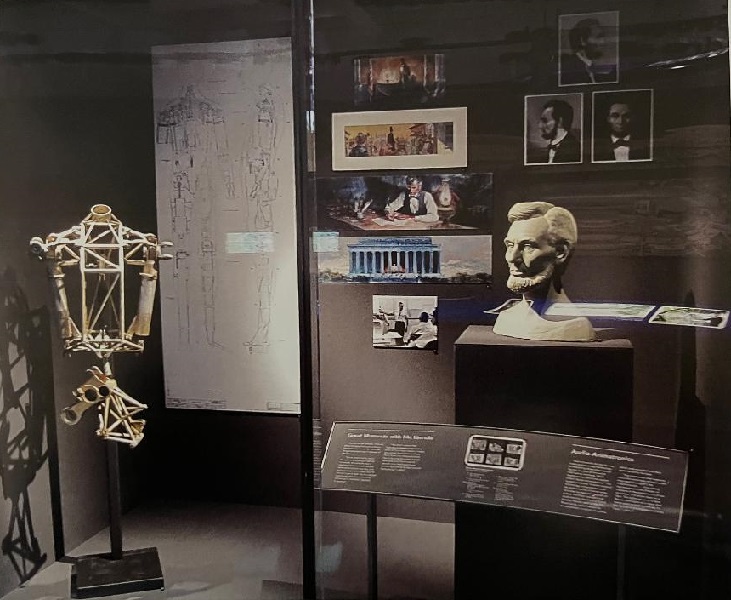
Toward the end of his life, Disney developed innovative attractions for global events, notably the 1960 Olympics and the 1964-65 New York World’s Fair. Beginning in 1960, Walt and his key creative executives approached several American corporations with the intent of collaborating on major shows and attractions for the 1964-65 New York World's Fair. The result was four of the most popular attractions at the Fair: the General Electric Progressland featuring Walt Disney's Carousel of Progress, the UNICEF Pavilion sponsored by Pepsi-Cola featuring, “it's a small world,” the Ford Wonder Rotunda featuring Walt Disney's Magic Skyway, and the State of Illinois Pavilion featuring Great Moments with Mr. Lincoln. These attractions were later exported to Disneyland in California.


Disney’s work with Robert Moses inspired him to develop a new paradigm, EPCOT (Experimental Prototype Community of Tomorrow), a project Walt described as “a community of tomorrow that will never be completed, but will always be introducing, testing, and demonstrating new materials and new systems…a showcase to the world of the ingenuity and imagination of American free enterprise.” With a unique city infrastructure that separated pedestrians and traffic, EPCOT foreshadowed the New Urbanism movement by 30 years.


Inside the Museum: An American Story

The stories of Disney’s life, creativity, family, and the processes and innovations he brought to his art will be told through a series of ten galleries. Highlights of the Museum will include:

• Drawings Disney made in his youth

• Drawings and cartoons from Laugh-O-gram Films, Disney’s first company

• Early drawings of Mickey Mouse

• Storyboards, a Disney innovation that mapped out timeless film classics

• The technically innovative Multiplane Camera that brought vibrancy and depth to his
revolutionary feature film, Snow White and the Seven Dwarfs

• The unique Snow White Academy Award®, which included a full-size Oscar® and seven
miniature castings

• The narrow-gauge Lilly Belle train he built for his Hollywood home, which recalled his youth
and helped spur his vision for Disneyland

• A model of the Disneyland of Walt’s imagination

Early drawings of Mickey Mouse

Throughout the exhibits, visitors will find rare film clips, concept art, scripts, musical scores, and cameras that Disney and his staff used in creating his characters and films. The visually stunning design incorporates movie posters that come to life to show scenes from Disney films, interactive light tables, and discovery drawers that add nuance and layer to the story of his life. Visitors will find hundreds of individual animation cels that reveal the labor-intensive animation process.


The exhibits will also pay tribute to Disney’s many groundbreaking achievements and innovations, among them:

• The first film that successfully synchronized sound and animation

• The first movie soundtrack released as a consumer recording

• The first original song from a cartoon to become a national hit (“Who’s Afraid of the Big
Bad Wolf?”)

• One of the first nature documentaries and the first to receive an Academy Award®


Disney and his family will be represented, as well, in photographs, artifacts, and home movies.
Although famous for his work behind the camera for Walt Disney Productions, Disney was an avid home moviemaker throughout his life. The Walt Disney Family Museum will exhibit to the public for the first time clips that ranged from experiments with trick shots (unspilling a glass of milk) to reels that documented Disney’s life at home with his wife, Lilly; his daughters, Diane and Sharon; and his brother and business partner, Roy, and his brother’s wife, Edna Francis.

Walt on Lily Belle.jpg

Walt Disney Family Museum: Facilities

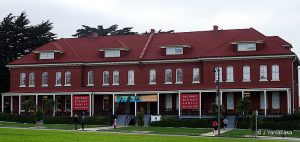
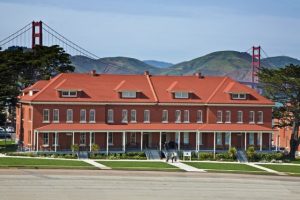
The Walt Disney Family Museum is located in three historic buildings within the Presidio of San Francisco, which is part of the Golden Gate National Recreation Area of the National Park Service. The centerpiece is a former army barracks at 104 Montgomery Street, redesigned and upgraded by architecture firm Page & Turnbull of San Francisco, and with interior architecture and installations designed by the Rockwell Group. The Museum uses the building’s original domestic-scale rooms to frame the story of Disney’s life and incorporates a wide range of materials and technologies, from historic documents and artifacts, to listening stations and other interactive displays, to more than 200 video monitors. In addition to the galleries, the Museum contains a 123-seat screening facility, a learning center, a store, and a café.


The Walt Disney Family Museum Exterior


The Museum campus includes a former gymnasium that houses the Walt Disney Family Foundation’s collections and offices. The building is the site of a 2,000 square foot hall that will be used for special programs and concerts until the special exhibition program begins in January 2012.

A third small building in the Presidio will house the Museum’s mechanical equipment.

The Walt Disney Family Museum, L.L.C. is owned and operated by the Walt Disney Family Foundation, a non-profit foundation. The Museum is partially funded by California Infrastructure and Economic Development Bank revenue bonds.

All admission to the Museum will be by timed-ticket entry.

Tickets go on sale August 1, 2009 at www.waltdisney.org.

The Walt Disney Family Museum Website will go live on August 1, 2009.

The Walt Disney Family Museum Facebook page and Twitter are live now at:

http://www.facebook.com/TheWaltDisneyFamilyMuseum and

http://www.twitter.com/WDFMuseum.


About The Walt Disney Family Museum

This page contains an archive of all entries posted to Disney News Blog in the The Walt Disney Family Museum category. They are listed from oldest to newest.

Sea World is the previous category.

Walt Disney World is the next category.

Many more can be found on the main index page or by looking through the archives.

Copyright © R.Y.I. Enterprises, LLC, All Rights Reserved, 1999-2009
Copyright © DWills, All Rights Reserved, 1996-1999
As to Disney artwork/properties: © Disney. All trademarks, service marks, and trade names are proprietary to Disney Enterprises, Inc., its subsidiary, affiliated and related companies, as the case may be.
AllEars®.Net, All Ears® Newsletter and any other properties owned by RYI Enterprises, LLC
are not affiliated with, authorized or endorsed by, or in any way officially connected with,
The Walt Disney Company, Disney Enterprises, Inc., or any of their affiliates.
Read more ABOUT US or ADVERTISE with us.
For official Disney information, visit http://www.disneyworld.com